Demonstration devices for windows and window films
Main menu:
Low-e Detector
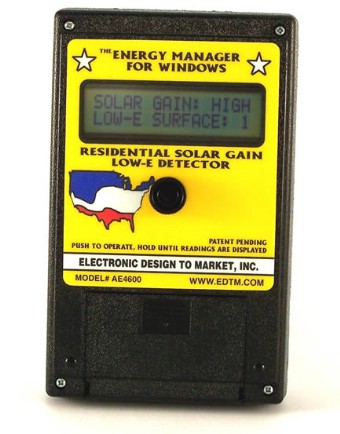
Solar Gain Low-E Coating Detector
The DIGITAL Solar Gain Low E Detector simultaneously identifies the location of Low E coatings on residential windows and also identifies the solar gain performance category of the coating. This solar gain value is then categorized into one of three ranges (HIGH, MEDIUM, or LOW Solar Gain). This measurement is based on the (center-of-glass) Solar Heat Gain Coefficient (SHGC) value of the window. The three ranges approximate the designations of the Energy Star Rating Program developed by the Department of Energy (DOE) and the Environmental Protection Agency (EPA). HIGH Solar Gain products are more desirable in northern cool climates while LOW Solar Gain products are perfect for southern warm climates.
The AE4600 meter is designed to measure transparent residential windows constructed of 3/32” or 1/8” glass. The meter is simple to operate. Place the meter against the window and read the results on the 2-line LCD display. You can take measurements from a single side of the window. The meter comes equipped with a 9-volt alkaline battery and a sturdy, padded carrying case.
The meter is great for identifying types of Low-E coatings, either in production or out in the field. This makes the AE4600 the perfect meter for production supervisors as well as field service personnel and home energy auditors. Take the results of your measurements and cross-reference them with the chart of popular low E products to the right. In many cases, you can identify the type of low e coating product you are working with.
Functions for Solar Gain & Low E Applications
• Differentiate hard coat from soft coat LOW- E
• Identify location of low e coatings
• Determine the solar gain properties of windows
• Estimate approximate SHGC value of a window
• Windows identified as HIGH, MEDIUM or LOW Solar Gain
• Designed for residential applications (3/32” - 1/8” glass)
• Perfect instrument for home energy auditors
• Great assistant for trouble-shooting in the field
• Identify types of Low-E glass quickly in production